

 |


|
|

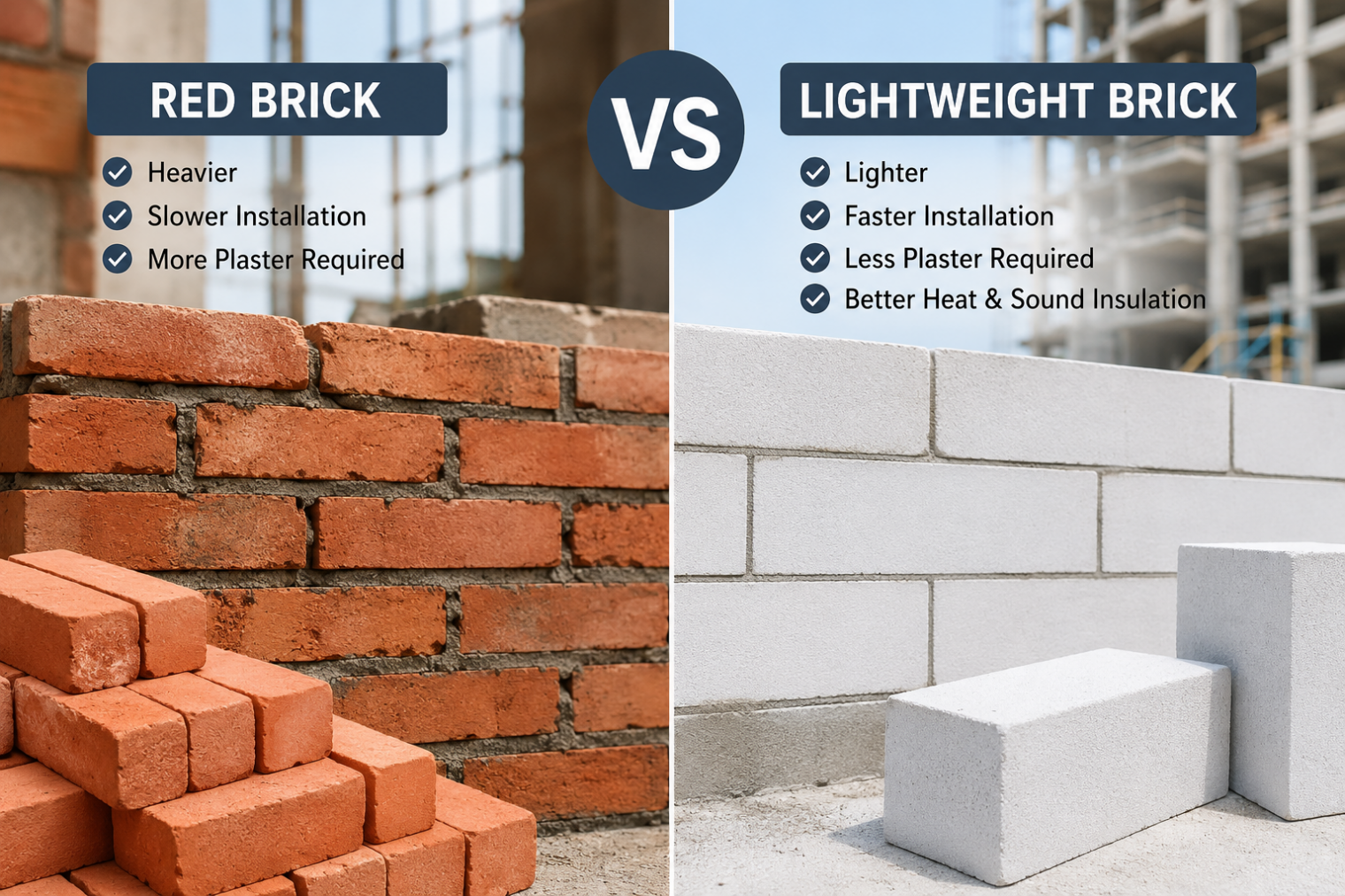
When planning a residential or commercial construction project, choosing the right wall material is one of the most important decisions. The debate between lightweight brick vs red brick remains a common consideration among homeowners, developers, architects, and contractors.
Both materials offer unique advantages, but as construction technology continues to evolve, lightweight bricks have become increasingly popular in modern projects due to their efficiency, consistency, and overall performance.
So, which one is the better choice? Let's take a closer look.
Red brick is a traditional building material that has been widely used for decades. It is made from clay that is molded and fired at high temperatures until it hardens.
Because of its availability and long-standing use in the construction industry, red brick remains a common choice for residential buildings, renovations, and smaller-scale projects.
Lightweight brick, commonly known as AAC (Autoclaved Aerated Concrete), is a modern construction material made from a mixture of quartz sand, cement, lime, water, and an expanding agent.
Manufactured under controlled factory conditions, lightweight bricks offer consistent quality, precise dimensions, and significantly lower weight compared to conventional bricks.
One of the most significant differences between lightweight bricks and red bricks is their weight.
Red bricks are denser and heavier, which increases the overall structural load of a building. Lightweight bricks contain millions of tiny air pockets that significantly reduce their weight while maintaining structural integrity.
Winner: Lightweight Brick
Their reduced weight helps decrease dead loads on foundations, beams, and columns, making them ideal for multi-story buildings.
Construction efficiency plays a major role in project timelines and costs.
Because lightweight bricks are much larger than traditional red bricks, workers can cover more wall area in less time. They are also installed using thin-bed mortar, which simplifies the application process.
Winner: Lightweight Brick
Faster installation means shorter construction schedules and reduced labor costs.
Traditional red bricks often vary slightly in size due to manual production and firing processes. These variations can lead to uneven wall surfaces that require thicker plastering.
Lightweight bricks are machine-manufactured with highly accurate dimensions, resulting in smoother and more uniform walls.
Winner: Lightweight Brick
This precision can reduce plastering requirements and improve finishing efficiency.
In tropical climates, thermal performance is an important factor for indoor comfort.
The porous structure of lightweight bricks provides excellent thermal insulation, helping reduce heat transfer from outside to inside the building.
Winner: Lightweight Brick
Buildings constructed with lightweight bricks often maintain cooler indoor temperatures, potentially reducing energy consumption for cooling.
Beyond thermal benefits, lightweight bricks also offer improved acoustic performance.
Their cellular structure helps absorb and reduce noise transmission, creating a quieter and more comfortable indoor environment.
Winner: Lightweight Brick
This makes them particularly suitable for homes, offices, and buildings located in busy urban areas.
At first glance, red bricks may appear more affordable due to their lower unit price.
However, total construction costs involve much more than the price of the material itself. Labor efficiency, installation speed, plastering requirements, and overall project duration all contribute to the final budget.
In many modern projects, lightweight bricks can deliver greater overall cost efficiency.
Winner: Depends on Project Scale
Red brick may be the preferred option for:
Small-scale renovations.
Traditional architectural styles.
Exposed brick designs with rustic or industrial aesthetics.
Projects where local labor is more familiar with conventional brickwork.
Lightweight brick is highly recommended for:
Modern residential homes.
Multi-story houses.
Commercial buildings and shophouses.
Office developments.
Apartment projects.
Fast-track construction schedules.
Projects prioritizing structural efficiency and energy performance.
When comparing lightweight brick vs red brick, lightweight brick offers clear advantages in terms of construction speed, structural efficiency, thermal performance, and overall project productivity.
While red brick continues to have its place in certain architectural applications, the construction industry is increasingly embracing lightweight brick as the preferred wall material for modern developments.
At Kabindo, we carefully evaluate every project's requirements to ensure the most suitable materials are selected. By combining thoughtful design, quality construction, and efficient building solutions, we help create spaces that are durable, comfortable, and built for long-term value.
Lightweight bricks are engineered to meet modern construction standards and offer consistent quality due to controlled manufacturing processes.
The material cost may be higher initially, but overall construction costs can often be reduced through faster installation and lower finishing requirements.
Yes. Its cellular structure provides excellent thermal insulation, helping maintain a more comfortable indoor temperature.
Lightweight brick is generally recommended because its lower weight reduces the structural load on the building.
Contractors appreciate lightweight bricks because they are faster to install, more precise, easier to handle, and contribute to greater overall project efficiency.
For SEO purposes, a stronger title could be:
"Lightweight Brick vs Red Brick: Which Wall Material Is Better for Modern Construction?"
This title targets the primary keyword directly while appealing to homeowners, developers, and potential construction clients searching for building material comparisons.


 Back to News
